If we have two different repeating patterns playing simultaneously and one has say 6 equally spaced steps and the other has 9 equally spaced steps then if both patterns complete in the same amount of time then this is called a polyrhythm. For both patterns to complete in the same amount of time then the step duration of the pattern with 6 steps must be longer than the step duration of the pattern with 9 steps.
But if both patterns have identical step durations then this is called a polymeter. For both patterns to have steps that last the same amount of time then the total duration of the 9 step pattern must be longer than the 6 step pattern.
So in a polyrhythm the step lengths are different but the cycle period is the same while in a polymeter the step lengths are the same but the cycle periods are different.
In the case of 6 step and 9 step patterns the ratio is 6/9 (which as a fraction can be simplified to 2/3). So in a polyrhythm the step of the 9 step pattern must be two thirds of the length of the step of the 6 step pattern and in a polymeter the 6 step pattern must last two thirds of the time that the 9 step pattern does.
In the polymeter case if the patterns begin in sync on the first step then because they have different cycle lengths they will go out of sync for a while. We can determine how many steps occur before both patterns return to synchronisation by finding the least common multiple of 6 and 9. This is 18 steps.
Given that most V/Bar sequencers have 16 or 12 steps that cycle in one bar how do we create polyrhythms and polymetric sequencing in LSSP?
For simplicity sake we’ll use CV Sequencers as these always have 16 steps regardless of the Song Control module’s BEATS/BAR setting.
Polymeter Demo
In both the polyrhythm and polymeter cases we want one CV Sequencer to cycle through 6 steps and the other to cycle through 9 steps so we can use a couple of Time Cycle Changer modules to change the cycle of a V/Bar signal fed to each sequencer.
So our initial patch looks like this…
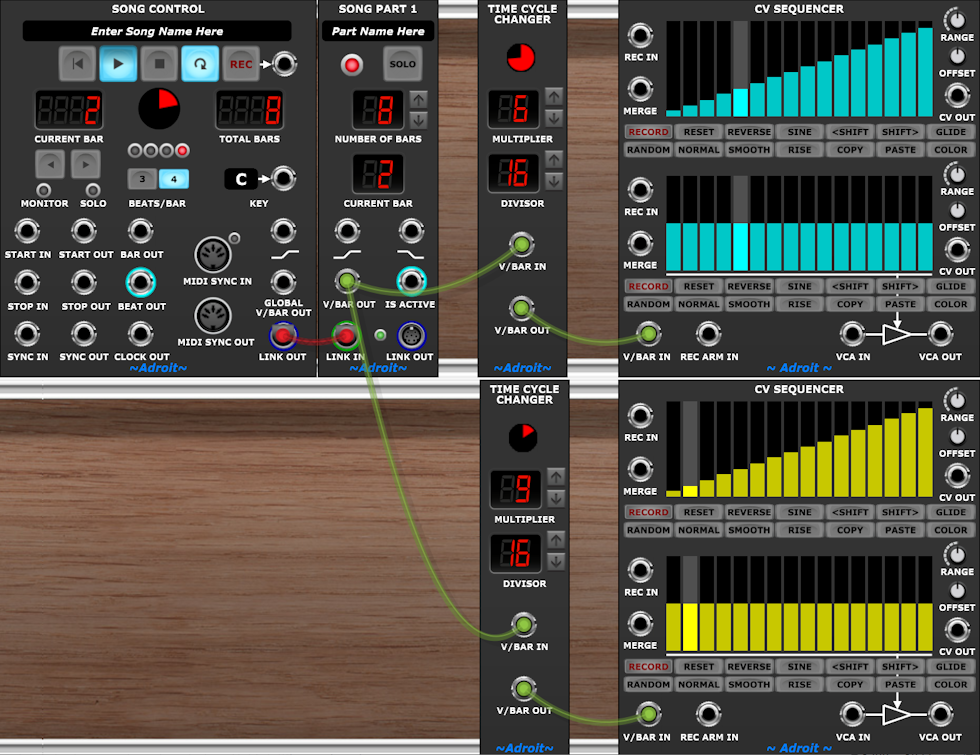
For polymetric sequencing this is essentially all that is required, so let’s turn it into a very crude practical demo patch.
Open the .voltagepreset file to launch Voltage Modular then click on the Song Control module’s Play button.
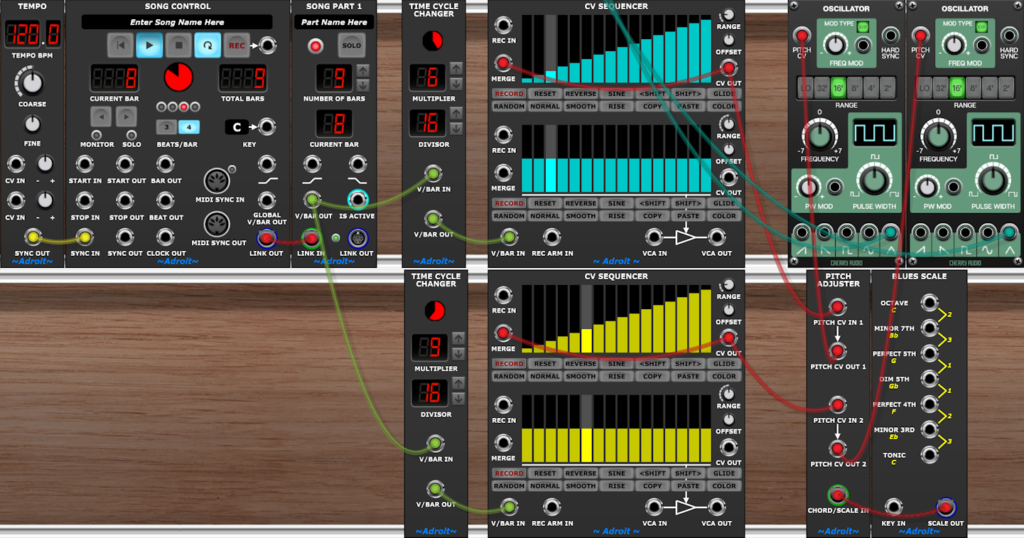
We use a VCO for each pattern with the 6 step pattern audible via the left stereo output and the 9 step pattern audible via the right stereo output.
The range of the CV Sequencer channels is reduced to 2 volts so that the maximum pitch range is two octaves and a Pitch Adjuster is used to quantize the notes to a Blues Scale to help reduce the dissonance caused by two unrelated pitches playing together.
Although the 6 against 9 polymeter repeats every 18 steps there’s another cycle involved – which is how many bars one loop of the song takes. Initially the Song Part module was set to have 8 bars which meant that the V/Bar reset every 128 steps but as 128 isn’t a multiple of 18 there was a “hiccup” every 8 bars. To not have a hiccup we need to find the least common multiple of 6, 9 and 16. The easiest way to find this is to type “LCM 6 9 16” into Google which will come back with the answer 144. We can then divide 144 by 16 to find the number of bars which gives us 9. So we set the Song Part’s NUMBER OF BARS to 9 and the hiccup disappears.
In realistic songs that use polymeter you may not always need to worry about perfect matching and least common multiples either because ostinatos fade out or you just accept that some polymetric patterns truncate (there’s no rule saying you can’t truncate). But by knowing about LCM you can attempt to find non-truncating solutions with Google if required.
Polyrhythm Demo
For polyrhythmic sequencing we need to adjust the step duration for each sequencer too. We can do this by adding a couple of Time Flow Changer modules.
The ratios for changing the time flow are exactly the same as for changing the cycles – 6/16 and 9/16.
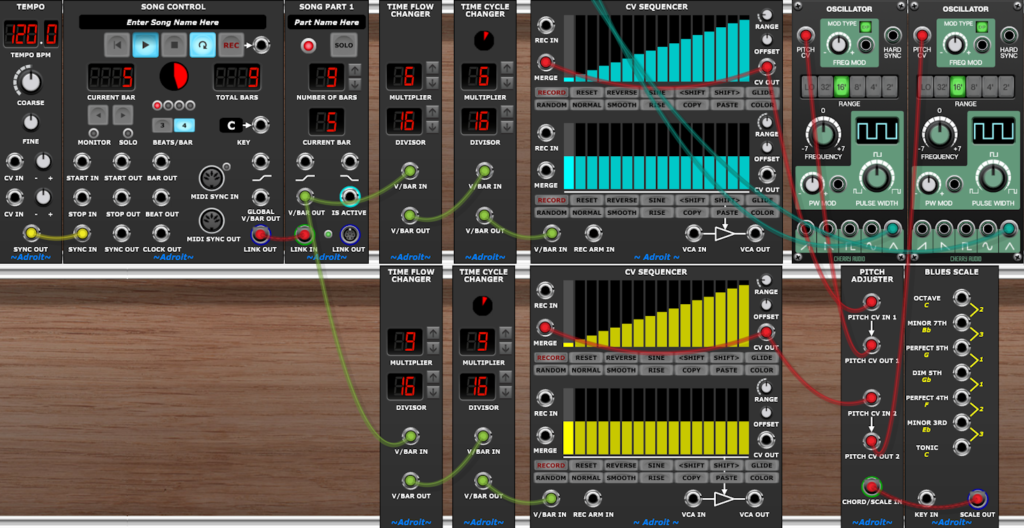
Using Time Flow Changers in series with Time Cycle Changers works but there’s a more convenient solution in the form of Time Changer modules.
Open the .voltagepreset file to launch Voltage Modular then click on the Song Control module’s Play button.
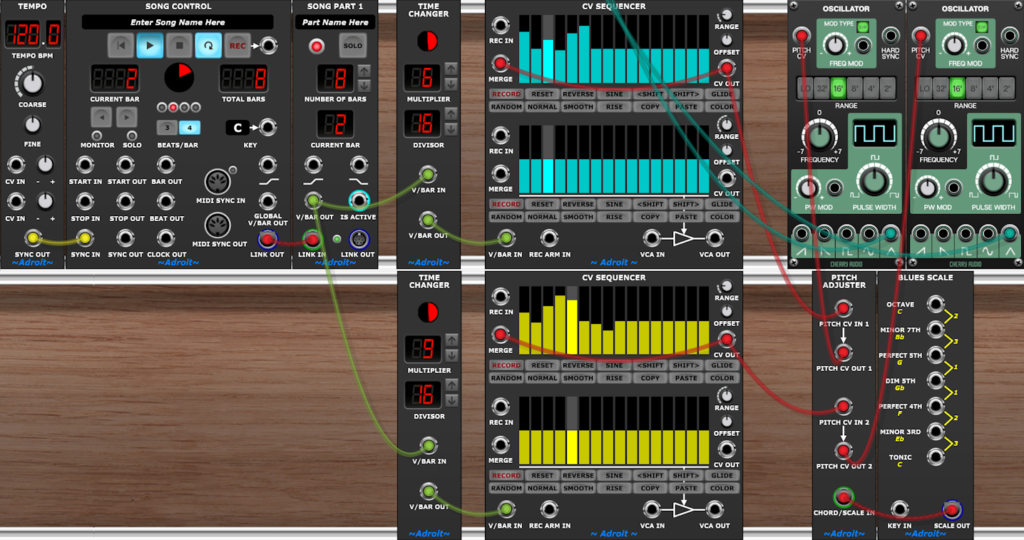
The pitch pattern of the cyan sequencer has been altered because polyrhthm with two rising arpeggios sounds pretty dull.
As you can see the Polymeter Demo and Polyrhythm Demo are almost identical. The only real difference is that the former uses Time Cycle Changer modules and the latter uses Time Changer modules.
More Sophistication
The demo patches above are obviously very crude. Deliberately so as it’s important to understand the core principles before doing anything more advanced.
Apart from them using just raw oscillator sounds, the rhythms are completely bare bones, In a more sophisticated setup we don’t want to be restricted to a simple and boring fixed pulse. Instead we might want to be able to use varied patterns that just happen to be structured on top of sequences made of equal spaced steps.
So in order to have more freedom we might want to increase the “resolution” by using multiples of the underlying numbers. So for a 6 against 9 polymeter or polyrhythm we might want to actually work with sequences that are 12 and 18 steps in length, or 18 and 27 steps in length or even 24 and 36 steps in length.
Fortunately this is easy to do with Time Splitters.
Here’s a 12 against 18 polymeter…
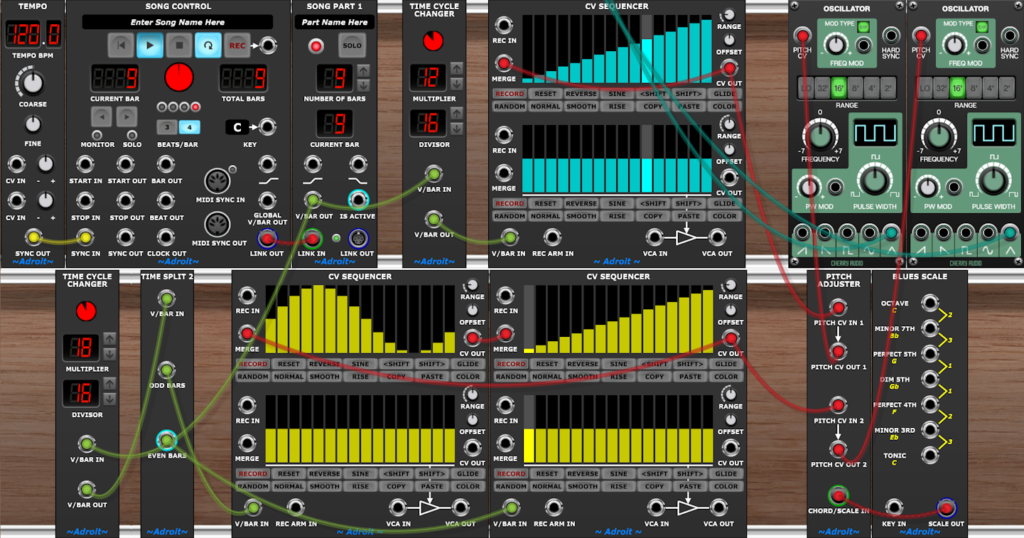
This is just a converted version of our earlier 6 against 9 polymeter demo so we are sticking with CV Sequencers.
To do the conversion we’ve simply increased the MUTIPLIERS to 12 and 18 and then because we’ve run out of steps on the yellow sequencer we’ve added an extra CV Sequencer using the usual chaining technique with a Time Split 2 module.
Exactly the same technique works with Time Changers for polyrhythms that require more than 16 steps.