** DRAFT DOCUMENTATION FOR UNRELEASED MODULE ***
The Time Cycle Changer helps us generate rhythmic patterns that won’t fit neatly into 16 (or 12) equally-spaced time divisions.
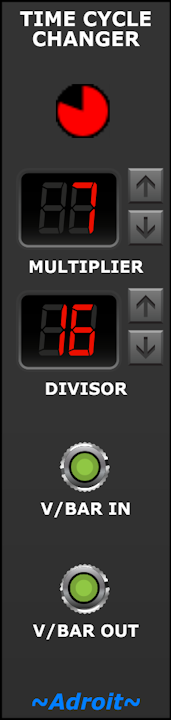
For instance if MULTIPLIER is set to 7 and DIVISOR is set to 16 then the range of an attached 16 step V/Bar sequencer will be limited to its first 7 steps.
This module is related to the Time Flow Changer but while Time Flow Changer speeds up or slows down the flow of time, the Time Cycle Changer alters how time cycles or repeats.
One way to look at cycles is to use a clock face analogy, Think of a clock face and how when 12 o’clock is reached the numbers wrap around and begin again so that 1 o’clock follows 12 o’clock. In this analogy Time Flow Changer alters how quickly the clock hour hand spins while the Time Cycle Changer alters how many hours are on the clock face. But instead of hours we are dealing with fractions of musical bars.
A pie chart graphic at the top of the Time Cycle Changer module shows how far through a cycle the module’s V/Bar output is – kind of like having a visualization of the “clock face”.
Unusual Time Signatures
If Song Control’s BEATS/BAR is set to 4 then LSSP sequencers like Rhythm Sequencer and Drum Sequencer use 16 steps. If BEATS/BAR is set to 3 then these sequencers use 12 steps.
16 steps is well suited for 4/4 related time signatures as 16 is a multiple of 1, 2, 4, 8 and 16.
12 steps is well suited for 3/4 related time signatures as 12 is a multiple of 1, 3, 4, 6 and 12.
Although most music uses 4/4, 3/4 or closely related time signatures we obviously don’t want to be limited to using only these kinds of rhythms in LSSP.
Time divisions like 5, 7, 9, 10, 11, 13, 14 or 15 don’t work with 16 or 12 step sequencers so we need some mechanism to build sequences with these odd number of steps and their multiples.
For instance if we want to create rhythms like those found in 5/4 time we need to be able to build sequences that are 5, 10 or 15 steps in length. Ideally we need to go beyond 16 steps too, to multiples like 20, 25 and 30.
Fortunately it’s relatively simple to achieve these things. For anything up to 16 steps we just process a sequencer’s V/Bar signal with a Time Cycle Changer.
For instance if we are driving a Rhythm Sequencer that has 16 steps (because BEATS/BAR is set to 4) then all we need to do is send the V/Bar signal through a Time Cycle Changer module that has its DIVISOR set to 16 and its MULTIPLIER set to 5, 10 or 15. As shown below.
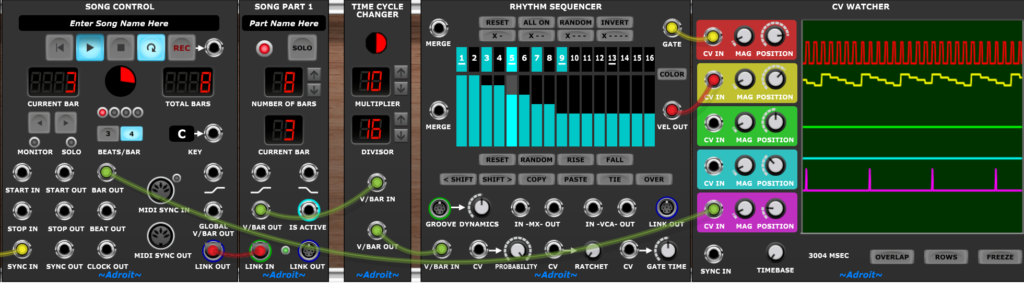
As you can hopefully see from the CV Watcher traces, the Rhythm Sequencer is outputting a 10 step pattern (5 note/rest pairs with falling velocity).
Note that although the Rhythm Sequencer is performing a ten step cycle it’s still running at the rate of 16 steps per bar.
It’s not obvious looking at the CV Watcher traces but the sequencer has a “hiccup” every 8 bars. If you look really carefully you can see it about half way along the yellow trace in the screenshot above. If you add a VCO with its pitch controlled by the Rhythm Sequencer’s VEL OUT it becomes obvious.
The hiccup is because the Song Part is set to be 8 bars long which means that it’s V/Bar output resets every 8 bars. As the Rhythm Sequencer is stepping 16 times per bar then the total number of steps between resets is 128, but the cycle set by the Time Cycle Changer is 10 steps and 128 isn’t a simple multiple of 10.
To not have a hiccup we can set the number of bars of the Song Part to be related to both 16 and 10. This relationship is called the least common multiple and the least common multiple for 16 and 10 is 80. So every 80 steps the 16 step and 10 step patterns will fall into sync. As 80 divided by 16 is 5 then we can stop the hiccup by setting the Song Part’s NUMBER OF BARS to 5 (or a multiple of 5).
Least Common Multiples are discussed with polymeters elsewhere but for now let’s just ignore the hiccup and change the flow rate of the V/Bar signal so that the Rhythm Sequencer steps at a rate of 10 times per bar instead of 16 times per bar.
This involves processing the V/Bar signal with a Time Flow Changer before it is processed by the Time Cycle Changer as shown below.
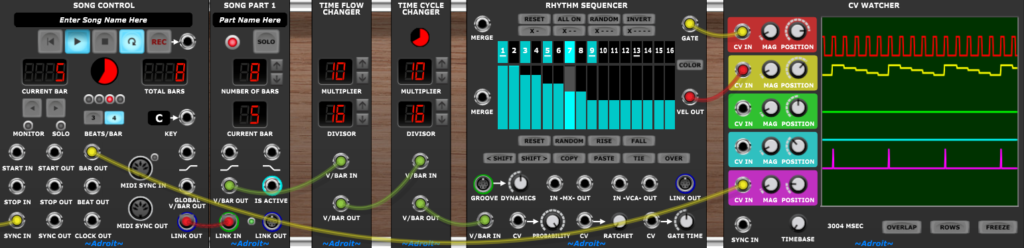
Notice that the MULTIPLIER setting on both modules is 10 and the DIVISOR setting on both modules is 16.
Now as well as having a 10 step cycle, the Rhythm Sequencer runs at a rate of 10 steps per bar.
The hiccup discussed above disappears because now the 10 step pattern repeats every bar so we can set the Song Part to have any number of bars.
Processing a V/Bar signal with a Time Flow Changer that feeds into a Time Cycle Changer with both modules having the same MULTIPLIER and DIVISOR settings is so useful that there is a single module called Time Changer that does this job. A key benefit of using this single module is that there’s only one set of controls to adjust.
Click here for a discussion on programming polyrhythmic and polymeteric sequences in LSSP.
Availability
The Time Cycle Changer module is part of LSSP XL.