Time Splitters are modules that distribute V/Bar timing signals in various musically useful ways. They allow V/Bar sequencers to be chained together to form linear sequences longer than a single bar and can also be used to create non-linear motif patterns such as AAB, AAAB or ABAC that reuse sequences.
Because the outputs of Time Splitters are V/Bar signals, hierarchies of time splitting can be built by feeding the output of one Time Spliter into the input of another.
The short video below shows the various Time Splitters in action over a 32 bar period. Note there is no sound, this is just illustrating the basic patterns that the modules create as shown by the rings around each output socket lighting up.
Note that the Time Splitter outputs are not gates, they produce V/Bar signals that vary over time. The light rings simply show when an output is 1 volt or higher. In other words when an output is producing a signal that will activate an attached Adroit Sequencer.
The Triggers module in the top cabinet isn’t a Time Splitter because its 16 outputs are 5 V triggers rather than V/Bar signals. It’s included in the patch to show how the V/Bar signal is varying between bars.
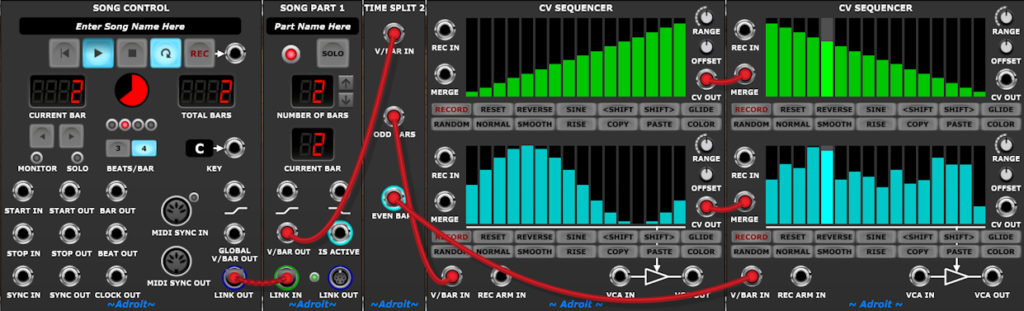
The Time Split 2, Time Split 4, Time Split 8 and Time Split 16 modules simply split up time into the indicated number of bars. So for instance to create a two bar long sequence a Time Split 2 module can be used to feed V/Bar signals to two sequencers.
Time Split Fills provides an easy way to create a time split where one sequence runs most of the time but another replaces it every now and then to punctuate the end of a musical phrase. For instance a kick drum pattern might repeat the same sequence for seven bars but use a variation on the eighth bar.
Time Split Build and Time Split Break are like mirror images of each other. Use the former to introduce new sequencing elements over time and the latter to drop elements out.
Time Split Binary provides timing signals that split time in two . For instance one sequence running for four bars and then another for four bars. This task can sometimes be handled more elegantly by a Song Part module but Time Split Binary offers you the flexibility to extend the range of other time splitters and divide time as needed without artificially messing with song structure.
Time Split Random is similar to Time Split 2 but with random choice.
Song Part is in effect a specialized type of Time Splitter that only works at the top of the timing hierarchy. Unlike the other Time Splitters it has a user selectable number of bars. Also Song Part modules have a couple of very useful outputs that provide control voltages that transition smoothly over the duration of a part. These can be used for all kinds of purposes such as to automate fade ins and fade outs using the Fader or Stereo Fader modules, cross fades and auto pans using the Dual VCA module and gradual tempo changes in combination with the Tempo module
Several V/Bar outputs can be combined simply by connecting them to the same input – so for instance a chorus can be defined just once and be activated by combining signals from the multiple Song Part modules that represent the individual chorus instances. This works because an inactive V/Bar signal drops to zero volts and therefore has no impact when mixed with an active V/Bar signal. (It’s kind of like an OR mechanism.)
Time Splitters will work at any speed and can also run backward, so can be useful in experimental patches and at rates where a one volt difference doesn’t necessarily refer to the musical period of a bar.
Use the Time Flow Changer module to speed up or slow down the flow of time. This module allows you to do things like slow down a Rhythm Sequencer so that it runs at two steps per bar over an 8 bar period instead of 16 steps over a single bar. Or you could perhaps drive a CV Sequencer at a rate of 16 steps per beat to create tempo-synced LFO modulations with user-programmable waveforms.