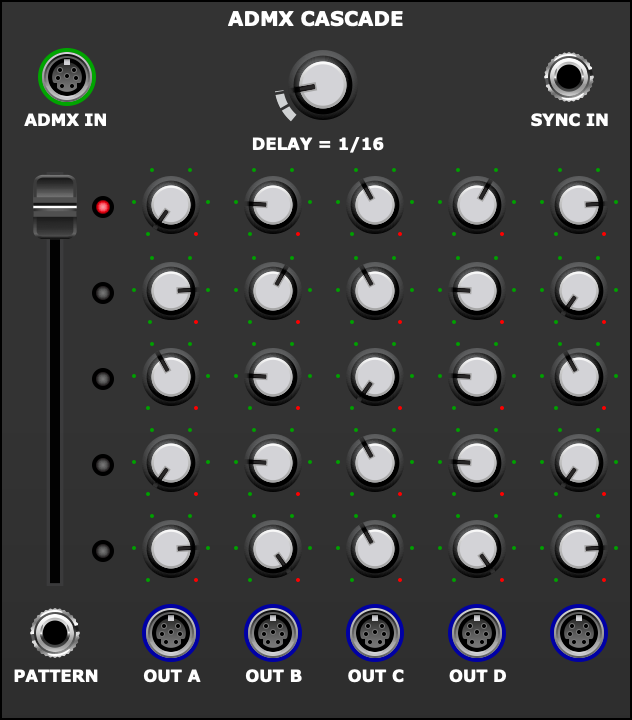
This ADMX module uses programmable multi-tap delay lines to produce interesting rhythmical lighting patterns when each output controls a different fixture.
It takes an ADMX signal as input and passes all 9 channels of its data through multi-tap delay lines. The delay time between taps is set by the SIZE knob and synced to the host tempo or a custom 96 PPQN sync signal if one is plugged into the SYNC IN socket.
The minimum delay is a 1/32 note while the maximum delay is 1 bar. Dotted delay intervals are represented with a period and triplet intervals with a T.
The large slider on the left selects which row of knobs in the 5 x 5 array is active. If a CV is fed to the PATTERN socket then the slider is disabled and the 0 V to 5 V control voltage selects which row is active instead. This feature lets you use a sequencer to switch between patterns to create larger scale tempo-synced animations.
Each knob in the active row selects what signal to send to the output socket beneath it. The knobs have six positions…
| 0 | No delay |
| 1 | Delay set by SIZE |
| 2 | 2 x Delay set by SIZE |
| 3 | 3 x Delay set by SIZE |
| 4 | 4 x Delay set by SIZE– |
| OFF | No delay and Brightness set to zero |
The patch below shows how you might use ADMX Cascade to create a left-to-right ripple effect using four moving head fixtures…
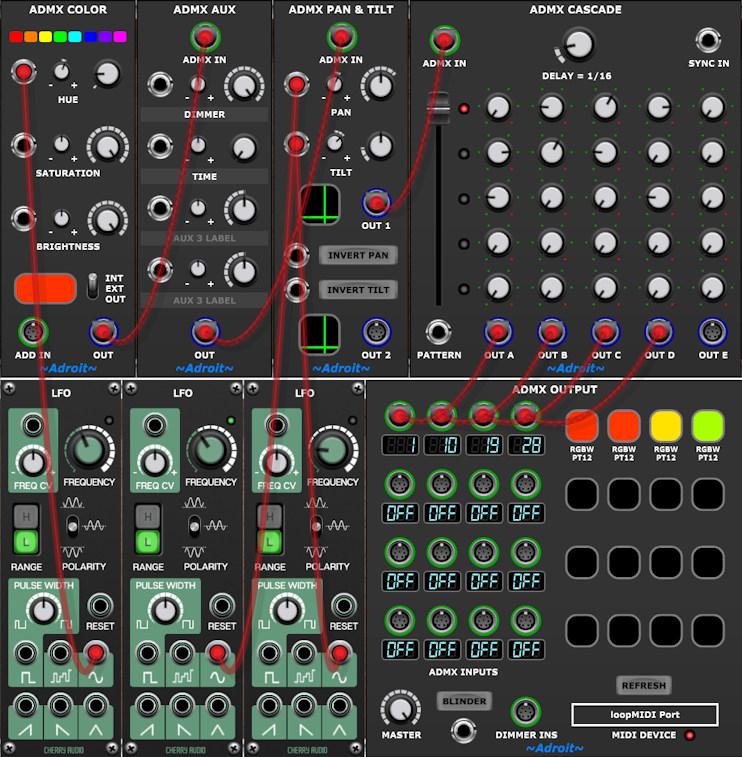
The LFO’s in the bottom cabinet slowly modulate the Hue, Pan and Tilt channels of an ADMX signal and this signal is then fed to the ADMX Cascade’s input. The A, B, C and D outputs from the ADMX Cascade module then drive a rig consisting of four moving heads via the ADMX Output module.
Because the PATTERN slider is at the top, the top row of tap select knobs are active and these are set so that there is no delay for OUT A, a 1/16 note delay for OUT B, a 2/16 note delay for OUT C and a 3/16 note delay for OUT D. OUT E is not used in this patch.

So athough the modulating LFO’s are free-running there’s still a 1/16 note tempo-synced correlation between the changes in the colors and positions of the moving heads.