This page looks at how the Time Flow Changer and Time Cycle Changer modules can be used to alter the behavior of V/Bar sequencers.
These two modules perform arithmetic on V/Bar signals but rather than focus too much on the math, it’s best to explore some examples in order to understand how they work and see why they are useful.
Please be aware that the demo patches presented here are stripped back to the bare minimum needed to demonstrate the principles so some details arent addressed and there’s nothing impressive sounding happening. Also note that although we’re using CV Sequencers, the same techniques apply when using other LSSP sequencers.
Flow and Cycle Demo
Click on the button below to download a .voltagepreset file then open the file to automatically load Voltage Modular with the Flow and Cycle demo patch ready built for you.
More information on downloading presets
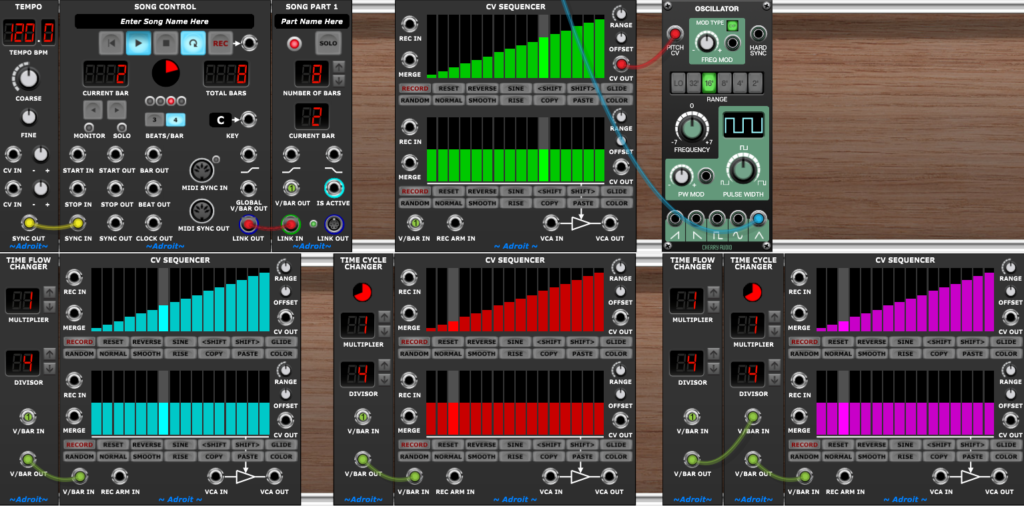
To cut down on cable clutter, Voltage Modular’s cable bus mechanism is used to connect the V/BAR OUT of the Song Part module to the V/BAR IN of various modules in the patch.
Click on the Play button of the Song Control module and take a look at the CV Sequencer that’s color coded green. This is being driven directly by the V/BAR OUT signal of the Song Part module and its upper channel is used to generate a 16 step rising pattern that’s controlling the pitch of the VCO. Nothing unusual here, this is just giving us a reference for standard behavior.
Listening to the raw VCO might seem a little pointless but it helps reinforce what’s going on.
Now reroute the red cable from the CV OUT of the green sequencer to the CV OUT of the upper channel of the cyan sequencer so that the VCO pitch is controlled by the cyan sequencer.
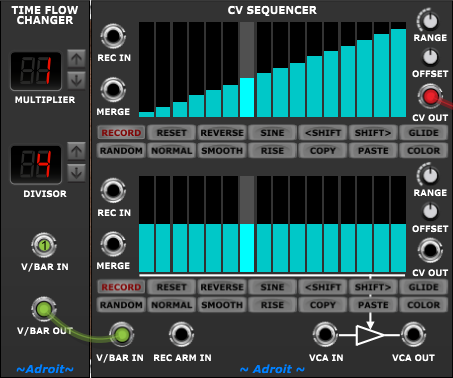
This sequencer is running at a quarter of the speed of the green one. This is because the Time Flow Changer processing the V/Bar signal is set to 1/4. Note that all 16 steps are still visited because although the V/Bar range is reduced by a factor of 4, the Song Part is set to have a range of 8 bars so even after the reduction the V/Bar signal fed to the cyan sequencer still has a two bar range.
If you change the NUMBER OF BARS parameter on the Song Part module to 1 then only the first 4 steps will be visited.
Change the NUMBER OF BARS back to 8 then reroute the pitch CV cable to the red sequencer’s upper CV OUT so that the pitch is controlled by the red sequencer.
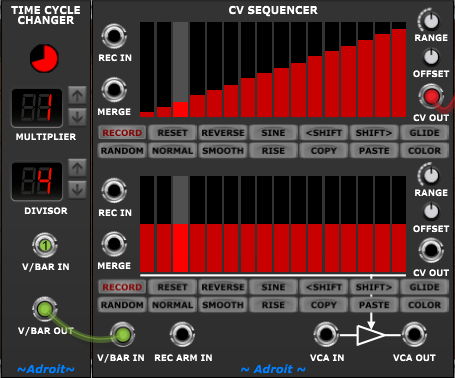
Notice how this sequencer changes step at the same rate as the green one but that only the first 4 steps are visited. This is because the Time Cycle Changer processing the red sequencer’s V/Bar is set to 1/4 and a quarter of 16 is 4.
Although the rate of step change is the same as on the green sequencer, the red sequencer’s shorter cycle obviously has to repeat four times in the same period.
If you change the Time Cycle Changer’s MULTIPLIER to 4 and its DIVISOR to 16 then you’ll get the same result. When driving a 16 step sequencer with a Time Cycle Changer it can make good sense to set the DIVISOR to 16 as the MULTIPLIER is then the number of steps range for a one volt change in V/Bar.
Now reroute the red cable from the CV OUT of the red sequencer to the CV OUT of the upper channel of the magenta sequencer so that the VCO pitch is controlled by the magenta sequencer.
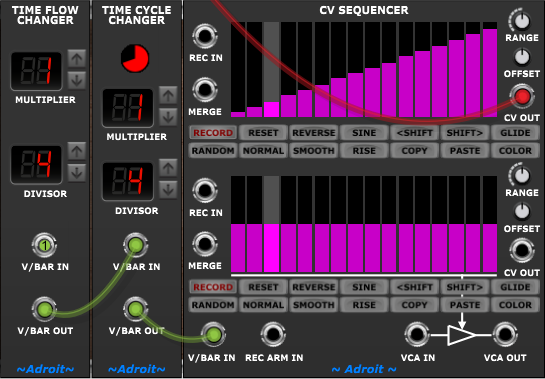
This sequencer is changing step four times slower than the green one because the Time Flow Changer processing the Song Part’s V/Bar output is set to 1/4 and only the first four steps are visited because the output from the Time Flow Changer is then processed by the Time Cycle Changer set to 1/4.
So the magenta sequence shows the combination of the effects shown by the cyan and red sequencers which is to be expected as the V/Bar goes through both a Time Flow Changer and a Time Cycle Changer,
Note that if we were to swap the processing order so that the cycle was changed before the flow, like this…
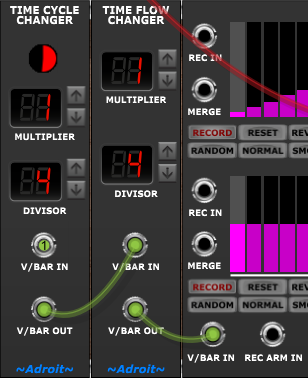
…then the magenta sequencer would just be stuck on the first step as the Time Cycle Changer would reduce the range of the V/Bar signal from the Song Part from 8 bars to 1/4 of a bar and the Time Flow Changer would then further reduce the range to 1/16 of a bar. So it’s important to remember that the order of processing matters when combining Time Flow Changers and Time Cycle Changers.
Flow, Cycle and Chaining Demo
Click on the button to download a .voltagepreset file then open the file to automatically load Voltage Modular with the Flow, Cycle and Chaining demo patch ready built for you.
We’ll do the same thing as with the first demo patch but with briefer descriptions. As before you can repatch the VCO pitch control cable to reinforce what’s happening by listening.
This is perhaps a bit laborious but it explains how the flow and cycle changes described for single sequencers can be extended to chains of sequences and even if you skip this section the information will be useful if you get stuck when doing something fancy in a future project.
Afterwards, we’ll move on something a bit more fascinating – polymeters and polyrhythms.
At the top of the patch we have the basic setup and two green colored CV Sequencers chained to form a 32 step sequencer as a reference.
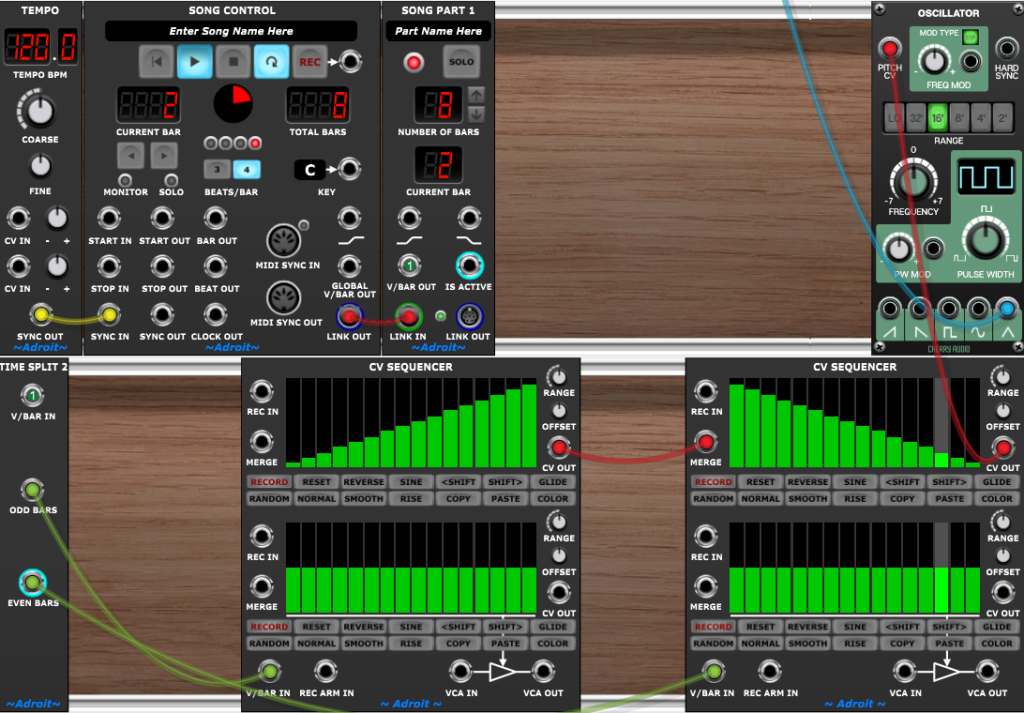
A Time Split 2 module splits the V/Bar signal from the Song Part module into odd and even bars.
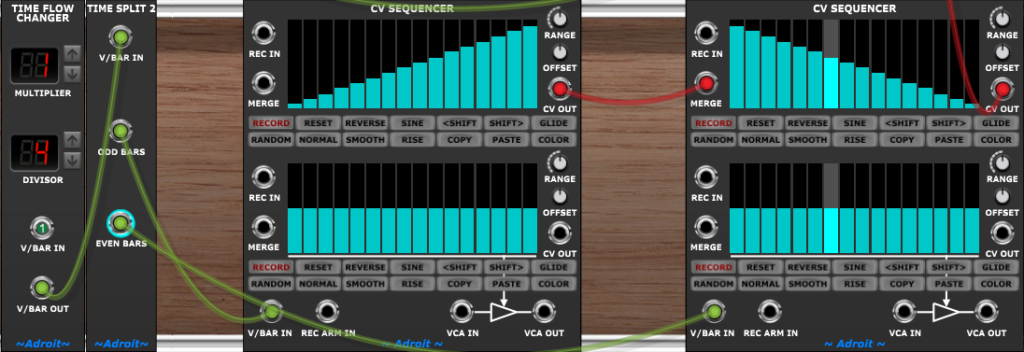
The 1/4 speed cyan 32 sequencer chain steps at a quarter of the speed of the green chain with all steps visited. As there are now 32 steps it takes 8 bars to complete the cycle. Which works fine because the Song Part is set to have an 8 bar range.
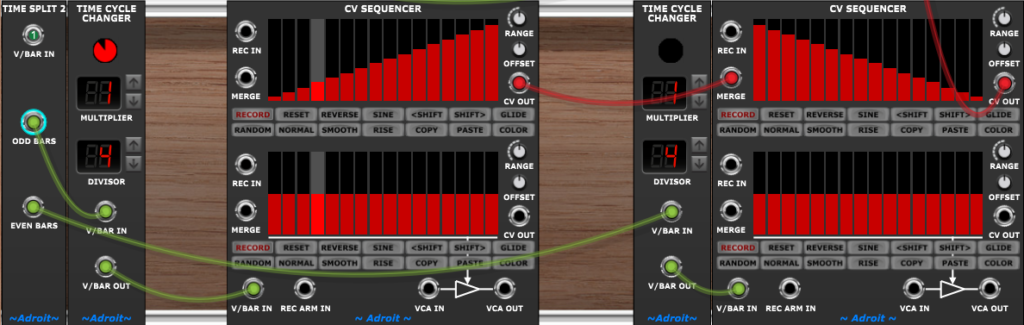
The red chain steps at the same speed as the green chain but splits the V/Bar into odd and even bars and then changes the cycle lengths on both paths to 1/4 so the left-hand sequencer plays its first four steps four times and then the right-hand sequencer plays its first four steps four times.
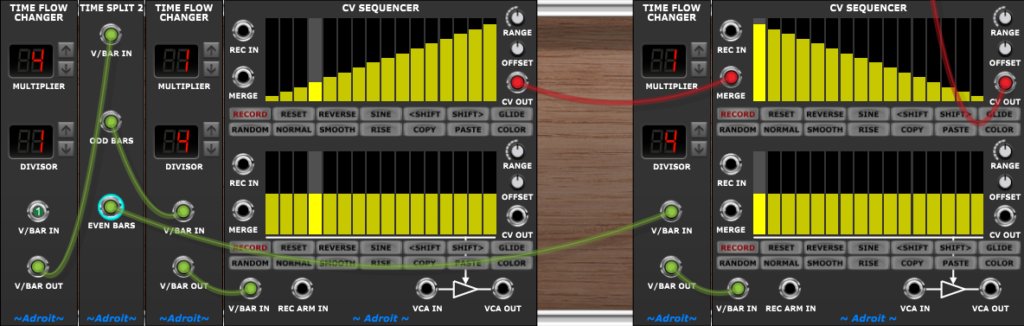
The yellow chain applies opposite flow rate changes either side of the time splitter.
This cancels out the flow change so the results in the same step speed as the green chain but now the left-hand sequencer plays its first four steps just once and then gives way to the right-hand sequencer playing its first four steps.